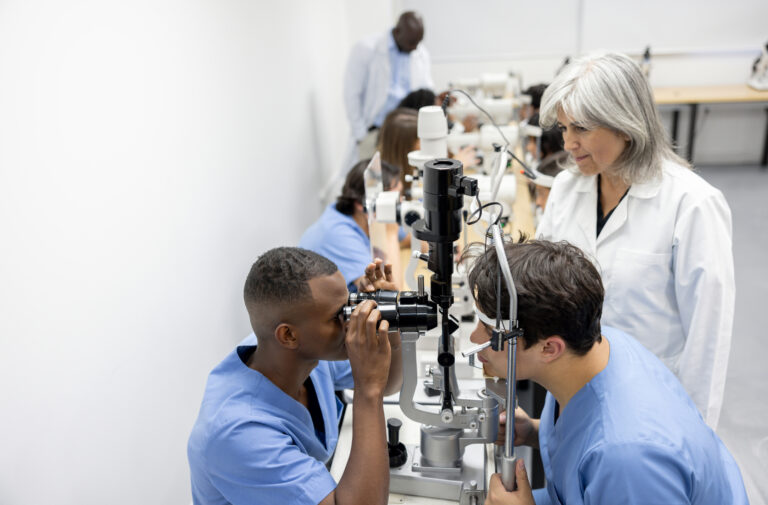
If you are an ophthalmologist preparing to choose your first position, you are stepping into an exciting new chapter of your life.
You are nearing the end of a lifetime of training—and as you prepare to choose your first position, you’re stepping into the most meaningful transition of your career.
By the time an ophthalmologist finishes residency, they’ve invested roughly 25 years in education and training—from kindergarten to college, through medical school and into a demanding surgical residency. When you translate that into time, it adds up to nearly 50,000 hours of structured learning, studying, and hands-on clinical experience.
That’s not just time in a classroom.
That’s years of developing judgment, refining surgical skill, and learning to care for patients in real-world settings where decisions matter.
And now, something shifts—in a good way.
For the first time, the path ahead is yours to shape.
After years of structured progression, you have the opportunity to decide what comes next—where you’ll practice, who you’ll work alongside, and what kind of career you want to build.
That’s exciting. And it’s significant.
Because choosing your first position is one of the first decisions where all of that training, experience, and perspective come together in a very real way.
At the same time, the process can feel a bit overwhelming.
Opportunities begin to come from multiple directions.
Recruiters reach out. Practices initiate conversations. Offers start to take shape.
On paper, many of the offers you’ll receive look compelling—strong compensation, attractive locations, and clear pathways toward growth or partnership.
But what is less obvious is this:
You’ve visited the practice, met with the physicians, and are now being asked to make an important decision with incomplete information… a little like going on a first or second date and wondering if you should say, “I do.”
For physicians who are trained to rely on data, clarity, and well-defined answers, that uncertainty can feel unfamiliar.
Because the real challenge is not finding opportunities.
It is learning how to recognize the right one—for you.
There’s also another important layer to this decision.
For years, your path has likely involved movement- migration from college, medical school, internship, residency, and for many, fellowship. Each step may have meant a new city, a new hospital, and a new rhythm of life—for you, and often for your family as well.
At some point, many physicians begin to look for something different.
Not just another step—but a sense of stability. A place to build a life and put down roots.
Because moving isn’t just logistical.
It’s emotional. It’s disruptive. And over time, it carries weight—for spouses, for children, and for the life you’re building outside of medicine.
That’s part of why this decision matters.
Not because your first position needs to be permanent—but because most physicians would prefer not to go through another major transition a year or two later if they can help it.
The goal isn’t to find a perfect job.
It’s to make a thoughtful, well-informed decision—one that gives you a strong foundation for both your career and your life.
And that’s exactly where the 7 P’s can help.
What should you consider when choosing an ophthalmology job?
In my experience working with young ophthalmologists, choosing an ophthalmology position means evaluating seven key factors: location, compensation, people, clinical philosophy, purpose, long-term potential, and overall job fit.
These factors—what we often call the 7 P’s (7 Priorities)—help bring clarity when everything else starts to feel crowded.
Before comparing offers in detail, it’s worth pausing to ask: What actually matters most to you in this next step?
The 7 P’s of Choosing Your First Ophthalmology Position
1. Place (Where You Will Live Your Life Outside of Medicine)
Location is often the first filter—and for good reason.
But “place” is more than geography. It includes proximity to family, access to airports, quality of schools, and the overall feel of a community. For many physicians, being within a reasonable distance of parents or extended family carries real weight.
Some prioritize this above nearly everything else. Others are more flexible if professional opportunities elsewhere are stronger.
Does this place support the life you want to build outside of medicine?
2. Pay (Understanding the Full Financial Picture)
Compensation, productivity bonuses, sign-on bonuses, stipends—all of these naturally grab attention early.
First-year ophthalmology offers can vary widely. In some markets—especially those that are harder to recruit to—starting compensation may reach $350K–$400K+ or more.
But two offers with the same salary can represent very different realities.
Pay reflects:
- Structure
- Expectations
- Collections model
- Long-term earning potential
- Partnership trajectory (if applicable)
A higher starting salary may come with trade-offs. A more moderate one may offer stronger long-term upside.
This is less about the number—and more about your time horizon.
Are you optimizing for your first year, or your long-term career?
And just as importantly: are you someone who naturally thinks long-term or short-term?
3. People (Who You Will Work With Every Day)
This is one of the most important—and hardest to measure—parts of any opportunity.
You can analyze compensation. You can review contracts.
But you experience people.
And over time, this often becomes the difference between a position that works—and one that truly fits.
Pay attention to early signals:
- How physicians speak about patients
- How staff are treated
- How decisions are made
- The tone of everyday interactions
And trust your instincts after the interview day.
Did conversations feel natural?
Did you leave energized and excited about your future—or unsure?
Could you see yourself learning from—and enjoying—these physicians over time?
Reputation matters here as well. A well-regarded practice in the community often reflects something real beneath the surface.
Do you genuinely respect and feel comfortable with the people you’d be joining?
4. Philosophy of Care (How Medicine Is Practiced Here)
Every practice has a clinical philosophy—whether it’s explicitly stated or not.
Some are more conservative.
Some are more procedural or growth-oriented.
Most fall somewhere in between.
This becomes more important over time, especially if partnership is part of the equation.
Because eventually, you’re not just taking a job.
You’re stepping into a way of practicing medicine—and making decisions when no one is watching.
Does their approach to patient care feel consistent with how you believe medicine should be practiced?
5. Purpose (Why the Practice Exists Beyond Profit)
Some practices are primarily operational.
Others carry a stronger sense of mission—serving a community, improving access, or building something meaningful over time.
Neither is inherently better.
But it’s worth noticing.
Because purpose tends to show up quietly—in how the work feels day to day.
For many physicians, this becomes more important as their career progresses.
Does this opportunity feel meaningful beyond the clinical and surgical workload?
6. Potential (What This Role Can Become Over Time)
A strong opportunity is not just defined by what exists today—but by what is likely to develop.
That might include:
- Growing surgical volume
- Subspecialty demand
- Partnership pathways
- Expansion opportunities
- Leadership roles
- Research or teaching opportunities
The key is grounding this in real indicators—not just optimistic language.
And also recognizing uncertainty—no one can predict everything.
Can you clearly see how this role could evolve over the next 3–5 years?
7. Position Fit (Where You Step In—and How You Grow)
At a practical level, this comes down to whether there is a true match between your training and the practice’s needs.
Early questions often sound like:
- Will I be busy?
- Where will my patients come from?
- Am I inheriting volume or building it?
- What does a typical week actually look like?
But just as important:
- Will I be trusted over time?
- Will I have room to grow surgically?
- Is there a clear path—not just expectations?
A thoughtful practice will have clarity around both demand and development.
Is there a real need for your skillset—and a plan for how you’ll grow into it?
What Is Driving Your Decision?
Most ophthalmologists tend to lean toward one or two primary drivers:
Place-driven — proximity to family or preferred region
Pay-driven — compensation and financial structure
People-driven — relationships and culture
Philosophy-driven — approach to patient care
Purpose-driven — meaning and mission
Lifestyle-driven — schedule and balance
Timing-driven — urgency to make a transition
There is no right answer.
But clarity here simplifies everything.
A Final Thought
Choosing your first ophthalmology position is not about finding a perfect opportunity. Even physicians who are very happy in their roles will tell you—no practice is perfect. It’s about understanding your priorities clearly enough that the right opportunity becomes easier to recognize.
The noise doesn’t go away.
But it becomes easier to filter.
And decisions begin to feel less overwhelming—and more grounded.
Not perfect.
But right.
Frequently Asked Questions About Ophthalmology Jobs
What matters most when choosing your first ophthalmology job?
Most ophthalmologists evaluate opportunities based on location, compensation, people, clinical philosophy, purpose, growth potential, and overall job fit. The key is understanding which of these matter most to you personally and professionally.
Should I prioritize salary in my first ophthalmology position?
Salary is important—especially for physicians with educational debt—but it should be evaluated alongside long-term earning potential, partnership opportunities, and how quickly you’ll be busy seeing patients and performing surgery.
How important is location when choosing an ophthalmology job?
For many physicians, location is the single most influential factor in their decision. Proximity to family, lifestyle considerations, and community fit often carry more weight than expected.
How do I evaluate ophthalmology practice culture?
Look for early signals: how physicians interact with staff, how patients are discussed, and how decisions are made. If possible, speak with current or former physicians who have worked in the practice.
What does potential mean in an ophthalmology job?
Potential refers to the long-term growth of the role, including surgical volume, patient demand, leadership opportunities, partnership pathways—and in some cases, research or teaching opportunities.
Is it normal to feel uncertain when choosing your first job?
Yes. Most ophthalmologists experience some level of uncertainty when signing that first employment agreement. The goal isn’t perfect certainty—it’s clarity about what matters most to you.
Thanks for reading.
For other free career resources pertaining to making wise job and partnership decisions for young ophthalmologists, reach out to us anytime at info@ojorecruitment.com